
Is Your Cash Drawer the Weakest Link in Your Australian Checkout?

It’s 5:40 on a Friday. The queue’s out the door, the card machine’s humming, and your cashier is jabbing at a drawer that won’t pop. Somebody’s got the key. Nobody knows who. The customer sighs, checks their phone, and wonders whether they should’ve gone next door.
That’s the thing about cash drawers. Nobody notices a good one. Everybody notices a bad one.
What Does a Cash Drawer Actually Do at the Checkout?
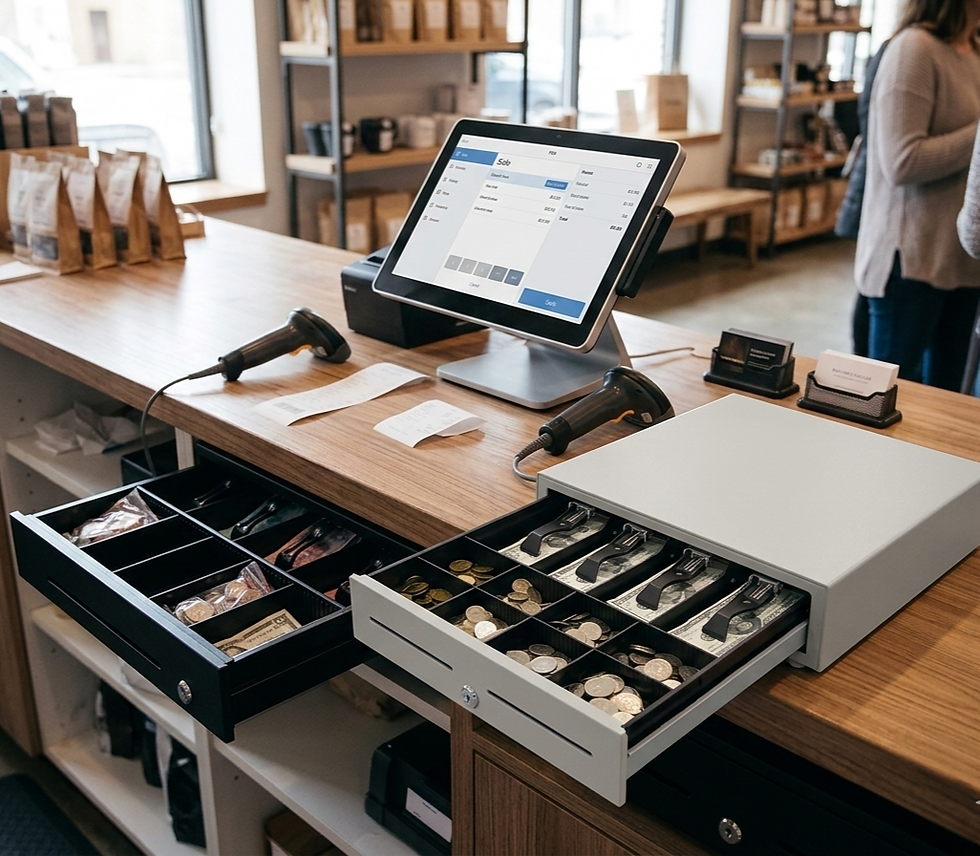
A cash drawer is a lockable steel tray that holds notes, coins and cheques at the point of sale. Most connect to a receipt printer through an RJ11 or RJ12 cable, so the drawer opens the moment a sale completes. No button. No fumbling. It keeps cash sorted, access controlled and your end-of-day count honest.
How Do You Choose the Right Cash Drawer Size and Voltage?
Start with the counter, not the catalogue. Measure the space, then check the drawer’s width and depth. A drawer that overhangs a bench is an elbow-bruiser waiting to happen.
Next, the layout. Most Australian counters run five note slots and eight coin slots (5N/8C), which is why that spec turns up everywhere. Cheque or media slots are handy if customers still pay that way.
Then voltage. Your drawer has to match what your printer or terminal sends out, either 12V or 24V. Get it wrong and the drawer buzzes, sticks or never opens. Check the printer’s spec sheet first, or ring us and we’ll check for you.
Which Cash Drawer Australia Businesses Pick, By Counter Type
Here’s how the range tends to match real counters.
Busy supermarkets and bottle shops want a workhorse. The NEXA CB910 is built for over a million transactions, with solid steel and a 5N/8C layout. It’s on special right now.
Cafés, food trucks and tight benches need less width. The NEXA CB710 squeezes four notes and eight coins into a 350mm body, with a 3-position lock.
Retail shops on a budget often land on the Goodson CD410 Economy. Removable tray, two media slots, and a manual emergency release if the power drops.
Boutiques that want the drawer to look good should see the Goodson GC-35, which has a stainless steel front.
Model | Best for | Notes / Coins | Price (inc GST) |
NEXA CB910 Black 24V | High-volume counters | 5N / 8C | $77 (was $129) |
NEXA CB710 Black 24V | Compact counters | 4N / 8C | $85 (was $115) |
Goodson CD410 Economy 24V | Everyday retail | 5N / 8C | $99 (was $129) |
Goodson GC-35 24V | Front-of-house looks | 5N / 8C | $139 |
Prices correct at time of writing.
NEXA Cash Drawers: Why Do So Many Shops Stick With Them?
Honestly, it’s the ecosystem. NEXA cash drawers come with accessories you’ll actually use later: a lock and key set, an under-counter mounting bracket, a lockable lid and replacement inserts. Lose a key in year three? Fixed in a day. Browse the full NEXA range.
Is a Goodson Cash Drawer Worth the Money?
A Goodson cash drawer earns its place on price and flexibility. There’s a manual push-button version, 12V and 24V options, and heavier builds like the GC-54 and CD415 if your counter sees real punishment. See the Goodson range before you decide.
Frequently Asked Questions
Can a cash drawer open without a receipt printer?
Yes. Serial and USB drawers connect straight to a computer, and manual push-button models like the Goodson CD410 open by hand. Printer-driven drawers need the printer to send the signal.
What happens if the power goes out mid-shift?
Many drawers include a key lock or manual release. The Goodson CD410 has manual emergency access, so staff can still reach the till and keep serving.
What’s the real difference between 12V and 24V?
It’s about matching the signal your printer sends. A 24V drawer on a 12V port may not open reliably, and the reverse can strain the printer. Match them and it just works.
How do I stop the wrong hands getting into the drawer?
Lock it every close and keep the key off the counter. A lockable lid on a CB910 and an under-counter bracket add a second layer, so the whole box can’t be lifted.


Comments